
Miami County Arrest Records and Charges
Miami County arrest records document the law-enforcement side of an arrest. That may include the arresting agency, booking path, custody status, bond information, and initial booking charges when public. The Miami County Sheriff's Office and Miami County Detention Facility are at 1104 W 200 N, Peru, IN 46970, with Administrative Office/Jail phone 765-472-1322. The detention facility opened in 2010 and has a 244-inmate capacity. The county site did not publish a Miami County-specific live jail roster in the research, so custody checks rely on jail contact, the Indiana County Jail Public Portal, Indiana SAVIN, and official court verification.
Court charges after arrest are different. The prosecutor decides what formal charges to file, and those charges become part of the court case. Miami County's Prosecutor represents the State of Indiana in local criminal matters and identifies the office as the people's lawyer in the criminal justice system. Filed court charges should be checked in MyCase and with the Clerk when a document or certified copy is needed. Jail booking detail belongs with custody records, while the full case outcome belongs in Miami County criminal court records.
The Sheriff's Office screenshot assigned to this page is sourced from the Miami County Sheriff's Office page.
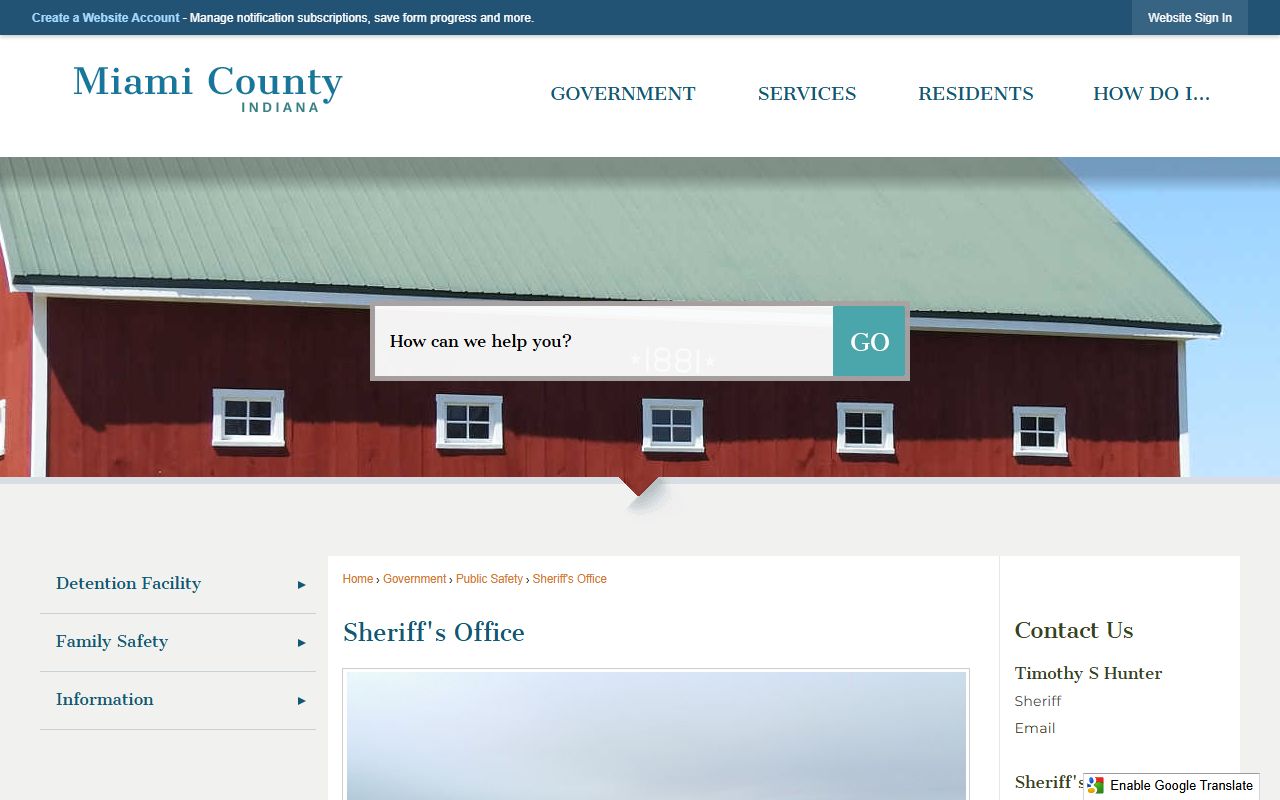
Use sheriff and jail channels for custody or booking questions, then verify filed charges through the court record.
Find Miami County Arrest Records
There is no official Miami County online arrest blotter or Sheriff active booking database documented in the research. For arrest and custody status, use the jail phone number, the Indiana County Jail Public Portal, Indiana SAVIN, and the Sheriff's Office public-record route when booking details are not online. For court charges after arrest, use Indiana MyCase and search by defendant name, case number, citation number, or cross-reference number.
- Check custody first through Miami County Jail, the Indiana County Jail Public Portal, or Indiana SAVIN when the person may still be in custody.
- Open MyCase to search filed court charges by defendant name, case number, citation number, or cross-reference number.
- Narrow results to Miami County and confirm the court name before reading the charge list.
- Review each charge for count number, offense description, statute, level or class, plea, status, and disposition.
- Contact the Clerk of Courts if the charging document or final order is public but not linked online.
Booking charges can differ from filed charges. The prosecutor may decline a count, amend it, file a different offense, reduce it, or dismiss it later. That is why a Miami County arrest record should not be treated as the final criminal case record.
Charges After Arrest in Miami County
After an arrest, the charge record begins when a formal charging document or court filing starts the case. Indiana county prosecutors are the local equivalent of a district attorney. In Miami County, the Prosecutor's Office is at 25 N Broadway, Room 116, Peru, IN 46970. The Criminal Division phone is 765-472-3804, the Traffic Division phone is 765-472-2403, and the Criminal Division fax is 765-472-4096. The Prosecutor also handles traffic deferral applications through a separate process for eligible infraction defendants.
| Document | Who Files It | What It Does |
|---|---|---|
| Complaint | Officer or prosecutor, depending on case type and procedure. | Starts or supports a criminal or infraction case with alleged facts and offense details. |
| Information | Prosecutor. | States formal prosecutor-filed charges without a grand jury indictment. |
| Indictment | Grand jury. | Charges an offense after grand-jury action in cases where that process is used. |
The Prosecutor screenshot assigned in the manifest is sourced from the Miami County Prosecutor page.
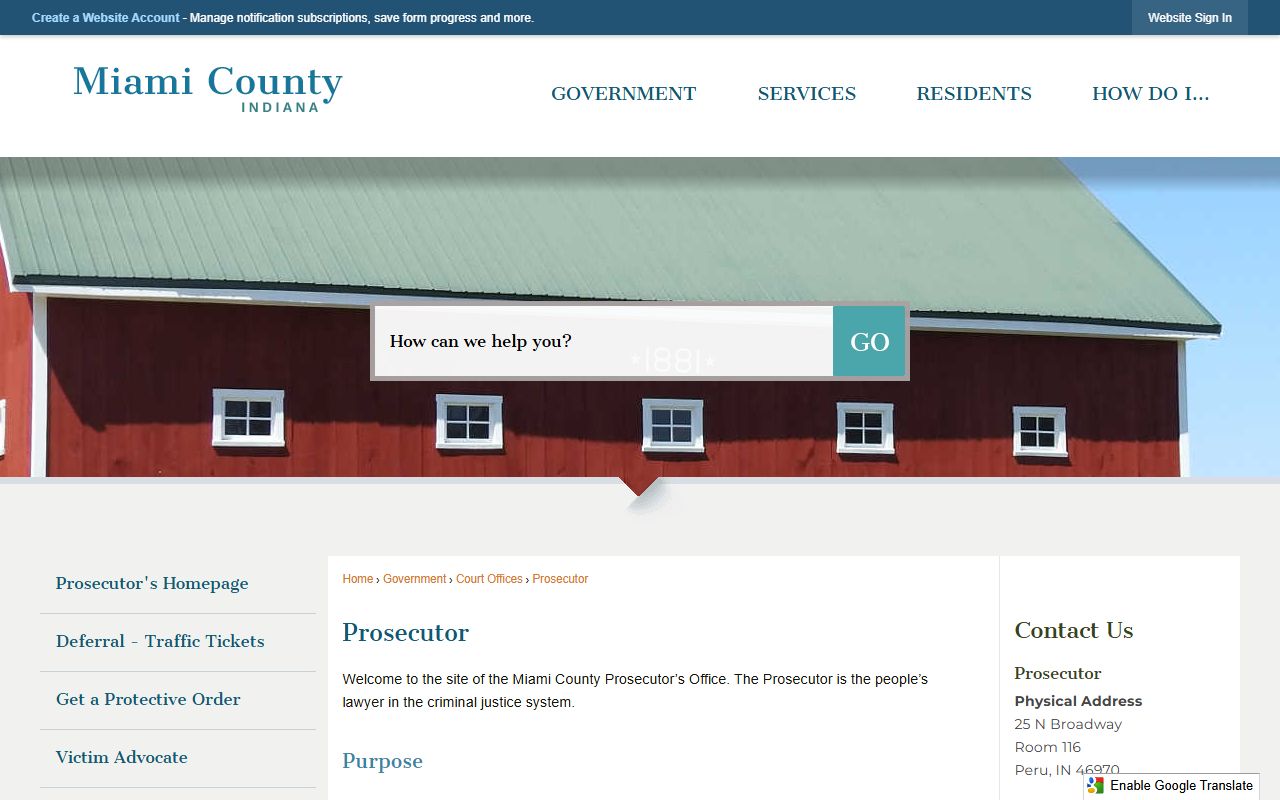
The Prosecutor files and handles charges for the State, while the Clerk maintains the court record once the case is filed.
Miami County Charge Status
Charge status changes as a case moves. A count may be pending at arraignment, amended before trial, reduced under a plea agreement, dismissed by the court, dismissed on prosecutor request, or resolved by conviction or acquittal. MyCase may show these changes as docket entries, charge fields, or disposition entries. Read the newest entries and the final order before relying on the current status.
| Status | What It Means |
|---|---|
| Pending | The charge is filed and not yet resolved by dismissal, plea, verdict, or other final action. |
| Amended | The prosecutor or court record changed the charge, count, wording, statute, or level. |
| Reduced | The charge moved to a lower level or different offense, often as part of case resolution. |
| Dismissed | The charge or case was ended without conviction on that count. |
| Convicted | The record shows a guilty plea, guilty finding, or judgment of conviction. |
A single arrest can produce several counts. Each count can have its own status, so the case result should be read count by count.
Miami County Charges vs Convictions
A charge is an accusation. A conviction is an outcome. Miami County arrest records and court charge records can show a person was arrested or charged, but that does not prove guilt. The docket must show a plea, verdict, judgment, disposition, or sentence before a charge should be treated as a conviction. This distinction matters for dismissed counts, amended counts, and cases that ended without conviction.
| Point | Charge | Conviction |
|---|---|---|
| Meaning | Formal accusation tied to a statute or ordinance. | Final guilty outcome by plea, verdict, or judgment. |
| Timing | Appears after arrest, citation, or charging document. | Appears after the court resolves the count. |
| Can Change | May be amended, reduced, dropped, or dismissed. | May lead to sentence, probation, fines, costs, or restitution. |
| Best Source | MyCase charge list and charging document. | Disposition, judgment, and sentencing entries. |
Charge Codes and Severity Levels
Miami County charge records may list a statute, count number, offense description, and level or class. Indiana classifies serious criminal offenses by felony level and lower-level criminal offenses as misdemeanors. Infractions are non-criminal violations, often traffic related, that can still create a court record and financial obligation. Superior Court II's local allocation expressly includes all non-driving misdemeanor charges and all non-driving Level 5 and 6 felony charges, while driving-related crimes and city-court matters should be checked by court name and case number.
Traffic charge records have a local wrinkle. The Miami County Prosecutor's Office runs a traffic pretrial deferral program for eligible infraction defendants with good driving history. The research lists disqualifiers such as being under 18 at the offense, no valid license, CDL, OWI conviction, recent moving judgment, recent deferral, speeding more than 25 mph over, school-bus passing, emergency-vehicle failure-to-yield, or an offense involving an accident. Deferral is not the same as erasing an arrest record; it is a prosecutor and court process for certain traffic citations.
Note: Charge codes identify accusations and levels; the disposition shows whether a count ended in conviction, dismissal, or another result.
Statewide Arrest and Charge Context
Statewide systems can add context, but each has limits. The Indiana County Jail Public Portal and Indiana SAVIN may help confirm custody or notification status. The Indiana Department of Correction locator is for sentenced state-prison offenders, not routine Miami County Jail booking. Indiana State Police NIBRS material provides law-enforcement reporting context for Miami County, but it is not a court charge lookup. Filed court charges should still be verified in MyCase and with the Clerk.
The NIBRS image assigned to this page is sourced from the Indiana State Police Miami County NIBRS page.
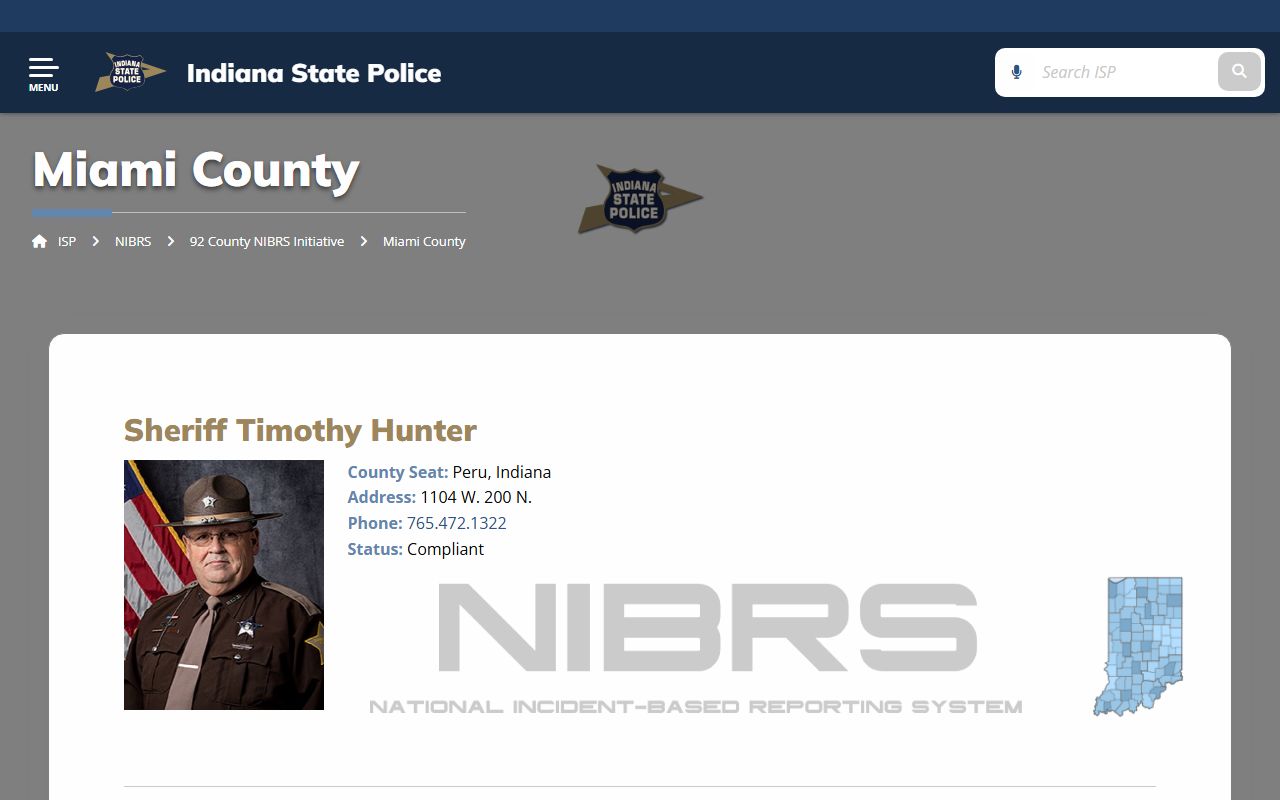
NIBRS shows reporting context, while a filed court charge must be checked through court records.
Sealed and Expunged Charge Records
Miami County charge records can be restricted by Indiana court access rules, juvenile-record law, expungement law, or a case-specific order. Indiana MyCase help says expungement cases may be visible while pending or denied, but once granted, public access can change depending on the expungement category. Arrest-only, dismissed, acquitted, misdemeanor, and felony records follow different statutory paths. Clerk staff can route filings and copies, but the local Clerk page cautions that deputies cannot provide legal advice.
| Point | Sealed | Expunged |
|---|---|---|
| Public Access | Blocked from ordinary public view by rule, statute, or court order. | Removed or restricted from public access after a granted petition. |
| Common Trigger | Juvenile, confidential, protected, or court-ordered limits. | Eligible criminal record under IC 35-38-9. |
| Effect | The record may still exist for authorized users. | Public access changes, but separate agency records may require separate authority. |
Restricted Miami County Charge Records
Restricted charge records include juvenile charges, sealed charges, expunged matters, protected-party records, and charges tied to confidential proceedings. Superior Court II hears juvenile delinquency and juvenile status matters, but those are not ordinary public charge records. Protection-order cases are not found in MyCase because protected-party names and identifying details are excluded from online public access. Search warrants, investigative records, and some active law-enforcement records can also be withheld.
For public filed charges, use MyCase first and the Clerk second. For custody status, call Miami County Jail or use statewide custody tools. For prosecutor action, use the Prosecutor's criminal or traffic division contacts. For a warrant concern after a missed appearance, verify through official court, Clerk, sheriff, jail, or attorney channels. Do not rely on third-party arrest or warrant databases for Miami County records.
Important: Arrest and charge lookups are not consumer reports and should not be used for FCRA-regulated screening decisions.